
Complete Guide to Gastronorm Pans: Sizes, Materials & Commercial Kitchen Uses
Modern commercial kitchens demand speed, consistency, hygiene, and efficient workflow. Whether it’s a luxury hotel in Mumbai, a cloud kitchen in Bengaluru, or a catering operation serving thousands of guests, kitchen professionals rely on one global system to streamline food preparation, storage, cooking, and service—the Gastronorm (GN) Pan system. But what exactly does it mean, and why it plays an important role in cullnary operations?
Origin of Gastronorm Sizes:
Gastronorm sizes were developed in Switzerland during the 1960s to solve a common problem in commercial kitchens—equipment and containers from different manufacturers often didn’t fit together. To bring consistency across the foodservice industry, standard dimensions for kitchen containers and trays were introduced on November 17, 1964. This became the foundation of the Gastronorm sizing system used worldwide today.
What are Gastronorm Pans?
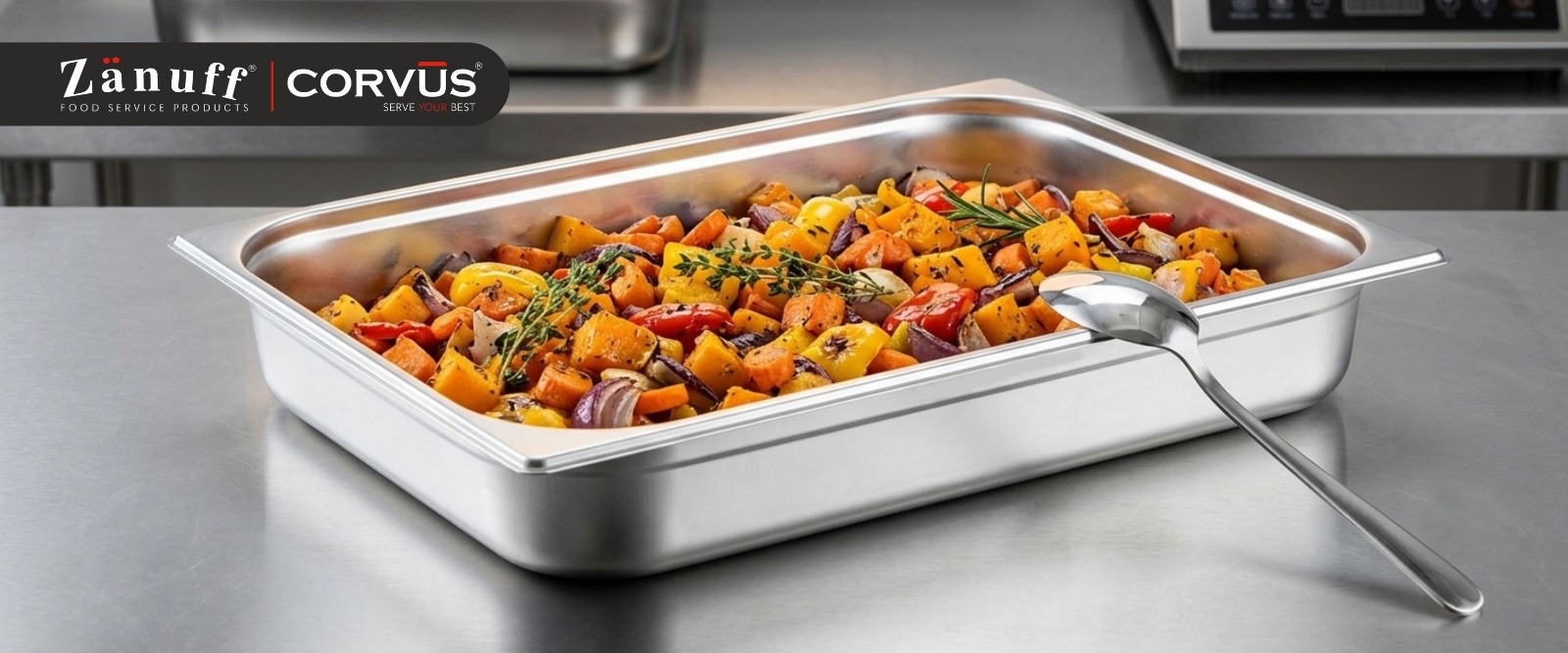
A Gastronorm (GN) Pan, commonly called a GN Pan, is a standardized food container used in commercial kitchens, hotels, restaurants, catering operations, and food service establishments worldwide.
The Gastronorm system was originally developed in Switzerland and later standardized under the European standard EN 631, ensuring that GN pans from different manufacturers fit perfectly into compatible kitchen equipment such as ovens, refrigerators, bain-maries, food display counters, trolleys, and storage racks.
Why are GN Pans Important?
The standardized sizing system allows food to move efficiently through every stage of food preparation and service:
Because all GN pans follow the same dimensions, kitchens can transfer ingredients and prepared food between different equipment without changing containers, saving time and improving operational efficiency.
The Complete Gastronorm Size Chart: From GN 1/9 to GN 2/1.
The foundation of the GN system is the GN 1/1 pan, measuring 530 × 325 mm. All other GN sizes are derived as fractions or multiples of this standard size, allowing multiple pans to fit perfectly within the same equipment well.
Why Fractional Sizing Matters
For example:
This interchangeable configuration allows chefs to customize layouts for changing menus, buffet displays, and ingredient stations without changing equipment. Holding in bain-maries. Their robust construction, resistance to corrosion, and easy-to-clean surface make them a long-term investment for hotels, restaurants, and catering operations. Stainless Steel GN Pans
GN Pan Size Chart
The table below outlines the most commonly used GN pan sizes, their dimensions, and typical applications in commercial food service:
| GN Size | Dimensions (mm) | Also Known As | Typical Use |
| GN 2/1 | 650 × 530 | Double Full | Large-batch cooking, banquet roasting, catering operations |
| GN 1/1 | 530 × 325 | Full Size | Buffet mains, hotel bain marie, chafers, general food service |
| GN 2/3 | 354 × 325 | Two-Third | Pasta stations, medium-volume hot dishes, buffet service |
| GN 2/4 | 530 × 162 | Half Long | Narrow chafer inserts, elongated buffet layouts |
| GN 1/2 | 325 × 265 | Half Size | Side dishes, salads, breakfast buffets, prep stations |
| GN 1/3 | 325 × 176 | Third Size | Sauces, condiments, mise en place, toppings |
| GN 1/4 | 265 × 162 | Quarter Size | Small sides, garnishes, salad bar ingredients |
| GN 1/6 | 176 × 162 | Sixth Size | Individual condiments, prep stations, ingredient storage |
| GN 1/9 | 176 × 108 | Ninth Size | Portion control, garnish trays, condiment bars |
The strength of the Gastronorm system lies in its interchangeable configuration. Different GN sizes can be combined to efficiently fill a single space, making kitchen operations more organized, flexible, and space-efficient.
Depth Guide: Choosing 20 mm to 200 mm for Indian Cuisine
While length and width remain standardized, GN pans are available in different depths to suit various food applications.
| Depth | Best For |
| 20–40 mm | Garnishes, sauces, toppings |
| 65 mm | Starters, salads, chaats |
| 100 mm | Curries, gravies, vegetables |
| 150 mm | Rice dishes, bulk preparation |
| 200 mm | Biryani, banquet service, large-batch cooking |
Selecting the right GN depth helps optimize pan capacity, reduce food waste, and improve service efficiency.
For example, Zanuff, a complete range of GN pans in various sizes and depths allows commercial kitchens to create customized foodservice setups while maintaining consistency across preparation, storage, cooking, and serving operations.
Polycarbonate Material:
Polycarbonate is a strong, lightweight, and transparent material that makes food identification quick and easy. Staff can instantly see the contents of a container without opening it, helping improve kitchen organisation and inventory control. Polycarbonate GN pans can withstand temperatures from -40°C to +99°C, making them suitable for refrigeration, food transport, cold storage, and display counters. Their durability and clarity have made them a popular choice in professional foodservice operations.
Polypropylene:
Polypropylene pans are often chosen for budget-conscious operations seeking reliable cold-storage and preparation containers. These pans typically withstand temperatures ranging from approximately -40°C to +70°C and are suitable for ingredient storage, food preparation, and transportation.
For kitchens that require oven compatibility and heavy-duty performance, stainless steel remains the preferred choice. For refrigerated storage and ingredient visibility, polycarbonate offers distinct advantages
SS 304 vs SS 201: A Critical Buying Decision
For Indian hotels, restaurants, caterers, and cloud kitchens, the choice between SS 304 and SS 201 GN pans directly affects durability, food safety, and replacement costs.
SS 304 (18/10 Stainless Steel)
SS 304 Material is commonly known as 18/10 stainless steel, containing approximately 18% chromium and 8–10% nickel. This chromium-nickel composition provides excellent resistance to rust, pitting, and corrosion, especially when exposed to acidic foods, moisture, and repeated washing. Zanuff’s SS 304 GN pans are manufactured with a robust 0.88 mm thickness, providing additional strength and durability for demanding foodservice operations.
Key advantages:
The Food Safety and Standards Authority of India (FSSAI) requires food-contact equipment to be manufactured from safe, non-reactive materials, making SS 304 the preferred choice for many commercial foodservice applications.
Stainless Steel 201,
SS 201, On the other hand, contains lower nickel content and relies more heavily on manganese. While it reduces upfront costs, it is generally more susceptible to rusting, staining, and pitting corrosion over time.
Advantages:
Limitations:
Many operators discover that the lower upfront cost of SS 201 is offset by premature replacement expenses due to corrosion.
This distinction is particularly important in Indian kitchens, where acidic ingredients such as tomatoes, tamarind, lemon juice, and vinegar are frequently used. Continuous exposure to these ingredients can accelerate deterioration in lower-grade steel products.
GN Pans in Action: Bain Marie, Chafing Dish, and Combi Oven Compatibility
One of the greatest advantages of GN pans is their universal compatibility across multiple types of commercial kitchen equipment. This standardisation enables the same pan to move through multiple stages of food preparation and service without requiring food to be transferred between containers. For example, a GN pan may be used for cooking in a combi oven, stored in refrigeration, placed into a bain-marie for hot holding, and finally presented in a chafing dish during buffet service. Because the food remains in the same container throughout the process, kitchens can reduce handling, improve workflow efficiency, and maintain more consistent serving temperatures.
The operational benefits become particularly significant in large-scale hotel buffets, banquet facilities, and institutional catering environments. Reduced food transfers mean less labour, fewer opportunities for contamination, and lower heat loss during service.
How to Choose the Right GN Pan for Your Kitchen Type
Selecting the appropriate GN pan requires an understanding of both kitchen workflow and menu requirements. Different pan sizes and depths are designed to support different operational needs.
For cloud kitchens and central production facilities, deep GN 1/1 pans with depths ranging from 100 mm to 150 mm are commonly used for bulk preparation and storage. Their larger capacity makes them suitable for curries, gravies, rice preparations, and batch-cooked ingredients, helping to minimise container changes during production.
Quick-service restaurants (QSRs), by contrast, often prioritise accessibility and speed. Shallow GN 1/3 pans are frequently used for toppings, sandwich ingredients, salad components, and mise en place stations. Their dimensions allow staff to access ingredients quickly while maintaining an organised preparation line. Smaller GN 1/6 pans are typically employed for condiments, sauces, garnishes, and chutneys, particularly within refrigerated prep counters.
Specialised applications may require perforated GN pans. These pans contain evenly distributed perforations that allow water, steam, or oil to drain effectively. In Indian foodservice environments, they are commonly used for steaming idlis, washing vegetables, draining fried snacks, or holding cooked pasta and noodles. The versatility of the perforated GN pan makes it a valuable tool in many commercial kitchens.
Ultimately, effective pan-to-equipment matching helps improve workflow efficiency, storage utilisation, and food handling practices. Sourcing platforms such as IndiaMART and manufacturers like Metal Processing Works provide a broad selection of GN pan configurations suitable for different foodservice formats.
GN Pan Prices in India: What to Budget and Where to Buy
GN pan prices vary based on steel grade, size, and gauge thickness. Stainless steel models are commonly available in the range of approximately ₹300–₹10,000 per piece,while polycarbonate covers often cost ₹70–₹200. When evaluating suppliers through platforms such as IndiaMART InterMESH Limited or TradeIndia, buyers should consider not only price but also gauge thickness, material certification, and GST registration to ensure long-term value.
Maintenance, Cleaning, and Longevity Tips for Indian Kitchen Conditions
Proper maintenance significantly extends the lifespan of GN pans.
After serving acidic foods such as tamarind-based curries, tomato gravies, or vinegar-containing preparations, pans should be rinsed promptly to minimize chemical exposure. Avoid abrasive steel-wool scrubbing pads, which can damage the protective surface layer of stainless steel.
For dishwasher cleaning, use moderate-temperature cycles and appropriate detergents. Excessively harsh chemicals can accelerate wear over time.
Hard water found in many cities may contribute to mineral deposits and pitting corrosion if pans remain wet for extended periods. To prevent this:
Polycarbonate GN pans typically last about 5–7 years in normal commercial use, depending on handling and operating conditions. However, they are not suitable for high heat (they may warp above ~99°C), can scratch easily and become cloudy over time, and may crack with sudden temperature changes. They are also less strong under heavy loads and generally have a shorter lifespan compared to stainless steel options.
Best only for cold storage, prep stations, and ingredient visibility—not for cooking or heavy-duty use.
In contrast, SS 304 GN pans are highly durable, resistant to corrosion, suitable for heavy-duty commercial use, and offer a much longer service life, making them a more long-lasting and reliable choice.
Regular maintenance not only improves hygiene but also reduces replacement costs and ensures reliable performance.
