
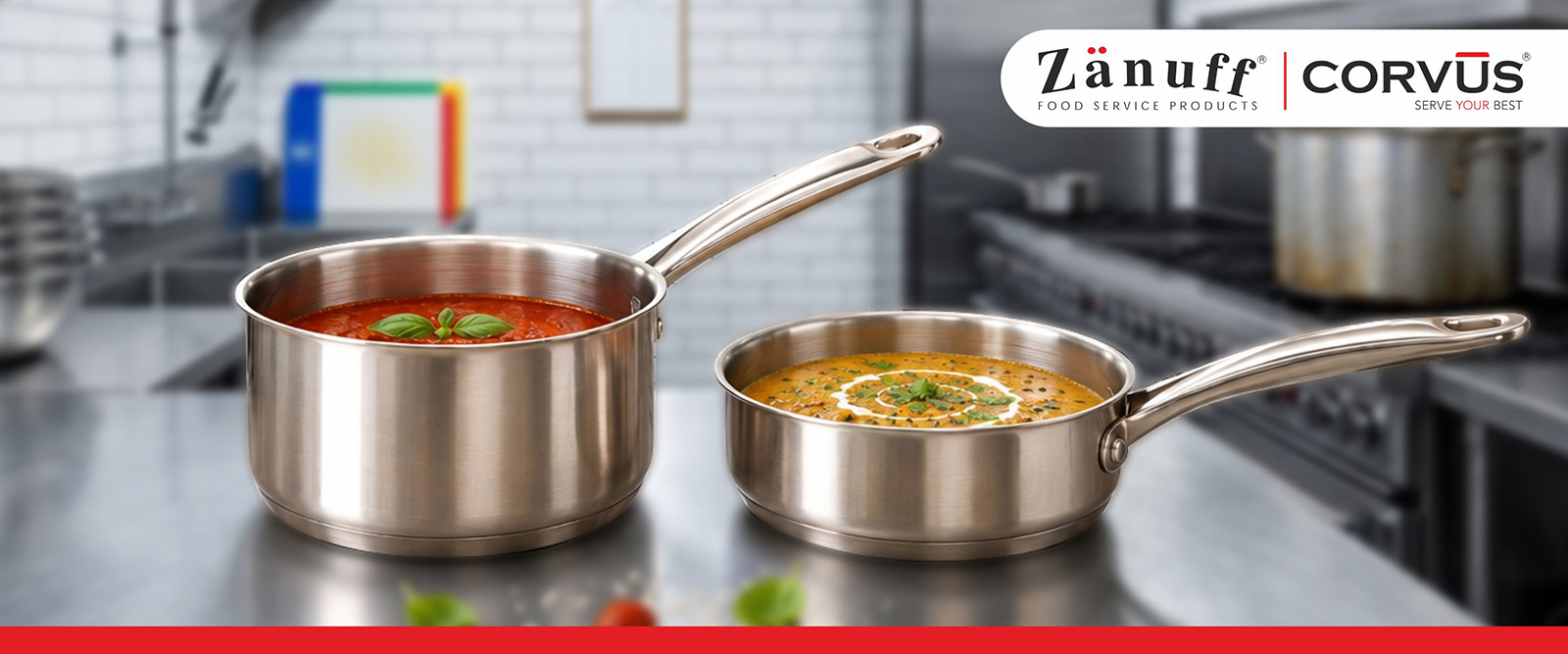
Commercial Pans & Saucepans Buying Guide for Professional Kitchens
A busy commercial kitchen needs cookware that can handle repeated cooking, high volumes and demanding daily use. The right pans and saucepans improve cooking consistency, workflow and durability while reducing unnecessary replacement costs.
For restaurants, hotels, caterers and institutional kitchens, cookware should be selected as working equipment—not simply by appearance or price. Material, thickness, construction, capacity, handles, heat-source compatibility and intended use all matter.
Don’t Miss: How Food Warmers Keep Buffet Food Safe, Fresh and Ready to Serve
What Makes Cookware Commercial Grade?
Commercial cookware is built for more frequent heating, handling and cleaning than typical household cookware. When evaluating a pan, look beyond gauge alone.
Check these six essentials:
A heavier gauge is not automatically better. The right thickness depends on the material, size, construction and intended workload.
Choosing the Right Material
Different materials perform differently. The best choice depends on your menu, cooking process and kitchen workload.
Best for: curries, gravies, dal, sauces, boiling and general cooking.
Because stainless steel does not conduct heat as quickly as aluminium, base construction or layered designs become important when even heating is required.
Best for: sautéing, bulk cooking and applications where quick heat response is important.
For regular use with acidic preparations, verify the aluminium grade, surface treatment and food-contact suitability before purchasing.
Best for: regular cooking and sautéing.
Always follow the manufacturer’s recommendations for cleaning and temperature use.
Best for: frying, sautéing, sauces and controlled cooking.
The key rule: Choose cookware for the cooking application, not simply the material name.
Which Pans Does a Commercial Kitchen Need?
You do not need every type of pan available. Build your cookware inventory around your menu, production volume and kitchen stations.
Frying Pans
For shallow frying, tempering, sautéing and quick preparations.
Sauté Pans
With a broad cooking surface and deeper sides, they work well for vegetables, gravies, sauces and finishing preparations.
Designed for liquid-based cooking such as dal, sauces, gravies, soups and reductions.
Stockpots & Large-Capacity Pans
Essential for batch cooking of rice, stocks, soups, curries, pasta and other high-volume preparations.
Task-Specific Cookware
Add specialised cookware only where your menu or cooking process requires it.
How to Choose the Right Size and Gauge
Choose capacity based on production volume—not simply burner size.
A pan that is too small can slow production and force multiple batches. An oversized pan can be unnecessarily heavy and inefficient.
Consider:
When comparing models, check diameter, capacity, gauge, base construction, weight, handle design and intended application.
There is no single “best gauge” for every commercial pan. A large vessel used for heavy production has different requirements from a small pan used for quick sautéing.
Food-Contact Safety: What Should You Verify?
Cookware used for food preparation should be made from suitable food-contact materials and meet applicable food-safety requirements.
For procurement, avoid relying on vague claims such as “FSSAI certified cookware.” Instead, ask the supplier for specific information on:
BIS IS 14756:2024 provides technical requirements for stainless steel utensils, including material, thickness, dimensions, finish and performance-related requirements.
A Smarter Approach to Bulk Procurement
For large restaurant, hotel or catering projects, start with the kitchen requirement—not the supplier catalogue.
1. Define the Requirement
List the dishes, batch sizes, number of cooking stations, daily production and heat sources.
2. Create a Specification
Specify:
Type • Diameter • Capacity • Material • Gauge • Base • Handle • Lid • Heat Source • Quantity
3. Compare Suppliers
Do not compare only unit price. Check MOQ, GST, delivery, packaging, payment terms, replacement policy and product documentation.
4. Request Samples
For larger orders, inspect the sample for weight, balance, dimensions, capacity, handle strength, rim quality, base stability and overall finish.
5. Test Before You Commit
Where practical, cook with the sample under real kitchen conditions. Check heat distribution, handling, cleaning and performance.
6. Confirm the Final Order
Before issuing the purchase order, reconfirm the exact specification, quantity, delivery schedule, invoicing and replacement terms.
Don’t Buy Commercial Cookware on Price Alone
The lowest purchase price does not always mean the lowest cost.
Poor construction, uneven heating, weak handles, incorrect sizing and frequent replacement can increase the total cost of ownership.
When comparing cookware, consider:
Purchase price + durability + cooking performance + ease of cleaning + handling + replacement frequency + supplier consistency
For professional kitchens, cookware should be treated as long-term working equipment.
The 6-Point Buying Check
Before placing your next cookware order, remember:
Material. Gauge. Size. Handle. Function. Supplier.
The Bottom Line
The right commercial cookware is not necessarily the heaviest, most expensive or most attractive option.
It is the cookware that matches your menu, workload, kitchen equipment and production needs—and performs reliably day after day.
For restaurants, hotels and catering businesses, a well-planned cookware set can improve consistency, efficiency and long-term value.
FAQs
What cookware is best for Indian commercial kitchens?
Stainless steel, aluminium, hard anodized and triply cookware can all be suitable. The right choice depends on the menu, cooking volume, heat source, heat response and maintenance requirements.
How many pans does a restaurant need?
There is no fixed number. Requirements depend on the menu, cooking stations, daily covers, batch sizes and service style. Start with the core pans required for your cooking processes and add sizes based on production volume.
What gauge is best for commercial cookware?
There is no universal best gauge. Thickness should be evaluated alongside material, pan size, construction and workload.
Are non-stick pans suitable for commercial kitchens?
Yes, for specific applications where reduced sticking is important. They should be treated as task-specific cookware and maintained according to the manufacturer’s instructions.
Is triply better than hard anodized?
Neither is universally better. Triply uses bonded metal layers, typically with an aluminium core between stainless-steel layers, while hard anodized cookware is treated aluminium. Their performance characteristics and ideal applications are different.
What should I check before placing a bulk cookware order?
Confirm the material, size, capacity, gauge, construction, handles, heat-source compatibility, quantity, documentation, delivery terms and replacement policy. Where possible, test a sample under actual kitchen conditions before committing to a large order.
